Postingan

Tree Diagram

Gambar
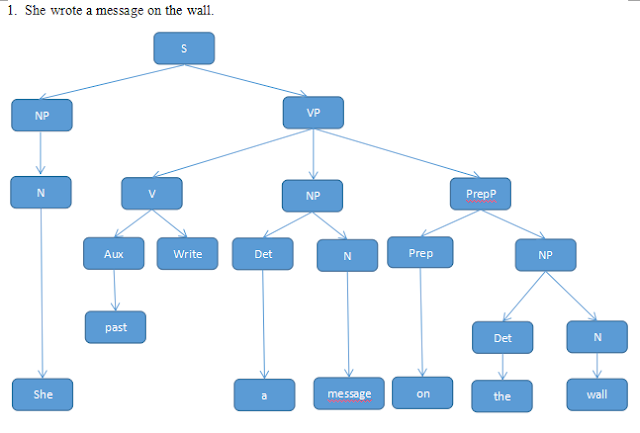
Hello, good people! in this very good ocassion i would like to present the tree diagram of sentences, of course in syntactically role. Just give me any comments if there are mistaken words i wrote here. i would be very happy if you could give me some critics. You can keep connecting with me in instagram shalsanurrahman  without @. thanks a lot good people! i know you have some questions about the abbreviations above. haha are you questioning what are they??? oh my goodness! good people i don't want to do the joke with you! S= Sentence, NP=noun phrase, VP= verb phrase, det=determiner, N=noun, V=verb, adv=adverb, aux=auxiliary verb, prep= preposition, adj= adjective actually, those emoticons are to change my perspective about Suzana. i am creepy enough of horror, so that's the reason why. huhu.

ADJECTIVE AND DETERMINER

Gambar
What is an  Adjective ? Adjective is words that describe or modify the quality of noun or pronoun. Examples: blue, bright, tall, short, thin, good, kind, etc. Let us make it into a sentence! Shalsa has a pretty thick curly black   hair . Now, break down the sentence and let us know the types and order of Adjective. Pretty - opinion Thick - size Curly - shape Black - color Here is the types and order of adjective! 1.  Number/Determiner ( a, an, two, some, three, etc) 2.  Opinion ( pretty, good, kind, ugly, etc) 3.  Size ( long, short, small, big, etc) 4.  Age ( new, old, young, ancient, etc) 5.  Shape ( triangle, round, square, straight, etc) 6.  Color (green, blue, red, brown, etc) 7.  Origin (Indonesian, malaysian, American, western, etc) 8.  Material ( metal, wooden, golden, plastic, etc) 9.  Noun/Pronoun ( table, book, man, girl, etc) We can easily remember how to arrange the adjective by memo...
ADVERBS In the parts of speech adverb plays an important role. Let us see what is it’s role ………….. Adverb:- Basically, most adverbs tell you how, where or when some thing is done. In other words, they describe the manner, place or time of an action. Commonly adverbs are formed from adjectives. Some are below. Adjectives Adverbs kind kindly happy happily wonderful wonderfully loud loudly sad sadly beautiful beautifully sweet sweetly Many adverbs end with ly. You make these adverbs by adding ly to adjectives. Note: Some words that end in ly are not adverbs. Some adjectives end in ly too. For Example:-      1.Sam was feeling very lonely.      2.She was wearing a lovely dress.      3.It was a very lively party Kinds of Adverbs Manner - describes in which manner an action is done. Place - describes where an action is done. Time - describes when an ac...
NOUNS AND PRONOUNS A noun  is the name of a person, place, thing, concept (idea), or quality. Person : Student     Poet     Teacher    Musician      Uncle       Writer Sculptor Place : college     home     garden     library   mall      beach      city      park     zoo Thing : apple     game     movie     book    test    homework     thumb     dinner    desk    bracelet These are Concrete Nouns because you can experience them with at least one of your senses. Abstract nouns are nouns that you can’t see, touch, smell, hear or taste. ...

PROCESSES WHERE NEW WORDS ARE FORMED

1.  Major Word Formation Processes (Processes that are formed frequently or commonly in the use of the English language) A.  AFFIXATION Process of forming words by adding affixes to morphemes English uses only prefixes and suffixes Sing + er = singer Un + er = unreal B.  COMPOUNDING Process that forms new words from two or more independent word s Examples of words formed by the compounding process: Girl + friend = girlfriend Text + book = textbook C.  REDUPLICATION Process of forming new words either by doubling an entire word (total reduplication) or part of a word (partial reduplication) English makes use of reduplication very sporadically Total reduplication is extremely rare! Humpty - dumpty Hocus - pocus D.  SUPPLETION A relationship between forms of a word wherein one form cannot be phonologically or morphologically derived from the other (this process is rare). Am vs. was Go vs. went 2.  MI...

A Glance of Morphology and Word Parts

A Glance of Morphology and Word Parts A root is the part of a word that cannot be changed, and when added to creates different forms of the word: "Walk" is a root, and can be changed in many ways: walking, walked, walker, walkie-talkie, sidewalk, walk-light, walks etc. You will never have a word related to walking where the "walk" part gets changed, so it is a root. Most of the time the root forms a word on its own, but sometimes they do not. complete, replete, expletive: these all have the root "plete", which happens to not be a word on its own. A stem is the form of a word that inflections get added onto. Most of the time this will be the root. "Walk" is the form that all the inflections (grammar-affecting changes) gets added to, when you add ~ing to it, it turns into a progressive verb or a gerund. ~ed turns it perfect. ~s makes it a plural noun, or makes it agree with a singular subject. A base is any part of a word that you ca...

My Introduction

Gambar
Hello, my name is Shalsa Billah Nurrahman. I was born on Tuesday, January 28th 199- in Brebes regency, Central Java . I am a student in IAIN Purwokerto. I am an English departement student, 5th grade.